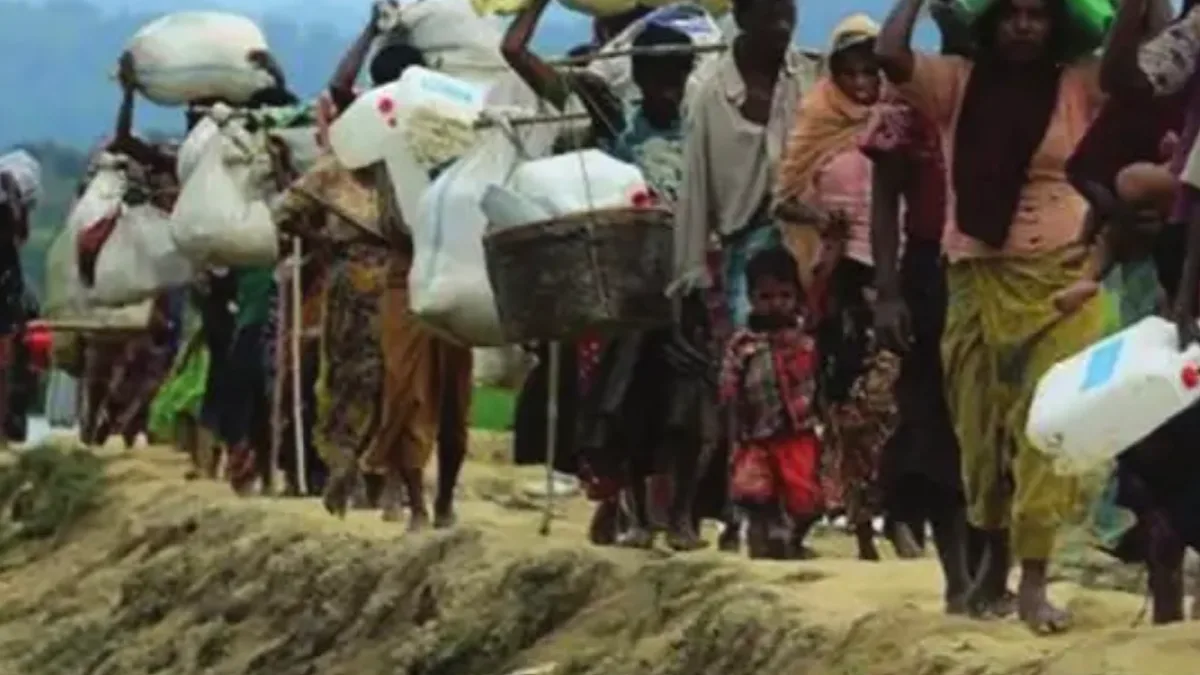
Recently, a habeas corpus petition concerning the alleged disappearance of five Rohingya individuals from custody was filed in the Supreme Court. The Chief Justice of India has rightly asked if the court was expected to “roll out a red carpet” for illegal entrants and questioned whether the individuals had legal status or a government order declaring them as refugees. This query gives birth to many legal and legitimate questions. And, of course, it is very difficult to answer those. Is habeas corpus applicable to foreigners in India? If not, is it not contrary to core constitutional values.
Are Rohingyas entitled to the protection of Article 21 of the Constitution (right to life and personal liberty)? Can any person on Indian soil be subjected to inhuman treatment? This controversy has many dimensions within the ambit of past practices of the Supreme Court under Article 21 and international law. While the Constitution does not use the exact term “human rights”, these rights (liberty, life etc.) align with international human rights standards, making them justiciable claims against the state. India is not a signatory to the 1951 UN Refugee Convention and 1967 Protocol and therefore, no legal status has been granted to the Rohingyas under Indian law.
Advertisement
But the principle of non-refoulement (not returning refugees to danger) is considered part of customary international law, obligating nearly all states to uphold it. A refugee seeking protection must not be prevented from entering a country. Nor can a refugee be forcibly returned to their home country or any other country where they could face persecution. The principle of non refoulement, which prohibits the return of a refugee to a territory where they may be at risk of persecution, torture, or other forms of serious or irreparable harm, is a norm of customary international law.
As such, it is binding on all States, whether or not they have acceded to the 1951 Convention or its 1967 Protocol. The Constitution under Articles 32 and 226 confers on the Supreme Court and High Courts respectively the power to issue writs to protect the fundamental rights of itizens. These include rights that are applicable to both citizens as well as foreigners (except in the case of the latter, Articles 15, 16, 19, 29, 30). Since habeas corpus is a writ against unlawful detention of a person, hence it is applicable to foreigners also. There is catena of cases where the Supreme Court established that while the government has broad power to expel foreigners, petitioners can use habeas corpus to challenge illegal detention, especially concerning rights under Article 21.
But courts balanced this with national security and sovereignty. In Ghulam Sarwar v. Union of India (1966) that dealt with a Presidential Order under Article 359, the Court confirmed foreigners’ right to challenge detention. It clarified that a presidential order under Article 359(1) did not completely bar judicial review of actions taken under emergency powers. In Louis De Raedt v. Union of India (1991) the Supreme Court held that the government’s power to expel foreigners is “absolute and unlimited,” but still affirmed due process rights, setting limits on executive discretion.
The Supreme Court ruled in the Chakma Migrants Case (1996) that non-citizens were also entitled to right to life. In National Human Rights Commission v. State of Arunachal Pradesh, the Court dealt with the matter of a large number of Chakmas who migrated from East Pakistan (now Bangladesh) in 1964, first settled in Asaam and Tripura and became Indian citizen in due course. Since the State of Assam had expressed its inability to rehabilitate all of them, about 65,000 of them were shifted to the State of Arunachal Pradesh. The All-Arunachal Pradesh Students Union (AAPSU) had threatened to forcibly expel them from the State.
Since all efforts to tackle the problem of their security had failed, the NHRC was compelled to approach the Supreme Court for appropriate relief. The Supreme Court held that the State was bound to protect the life and liberty of every being, whether citizen or non-citizen, holding that it is the constitutional duty of the State to safeguard the life, health and well-being of Chakmas. The court also directed Arunachal Pradesh to take all possible steps to ensure safety of Chakmas and their life and personal liberty. The court went to the extent of saying that any attempt to forcibly evict or drive them out of the State by AAPSU must be repelled by force considered necessary to carry out the direction of the court.
The Supreme Court has reiterated in various cases that the foreigners lack Article 19 rights to reside in India, but detention must still comply with Article 21, limiting grounds for challenge to illegal confinement. On a scrutiny of the cases, one finds that foreigners’ rights are limited and valid challenges through habeas corpus focus on detention violating Article 21, such as lack of reason, procedures under the Foreigners Act, or illegal confinement, and not the decision to expel itself. Indian courts recognize broad executive power in immigration and expulsion, but not absolute power to disregard due process. Courts balance individual rights with national security, border control, and public interest.
(THE WRITER IS PROFESSOR OF LAW, ALIGARH MUSLIM UNIVERSITY.)